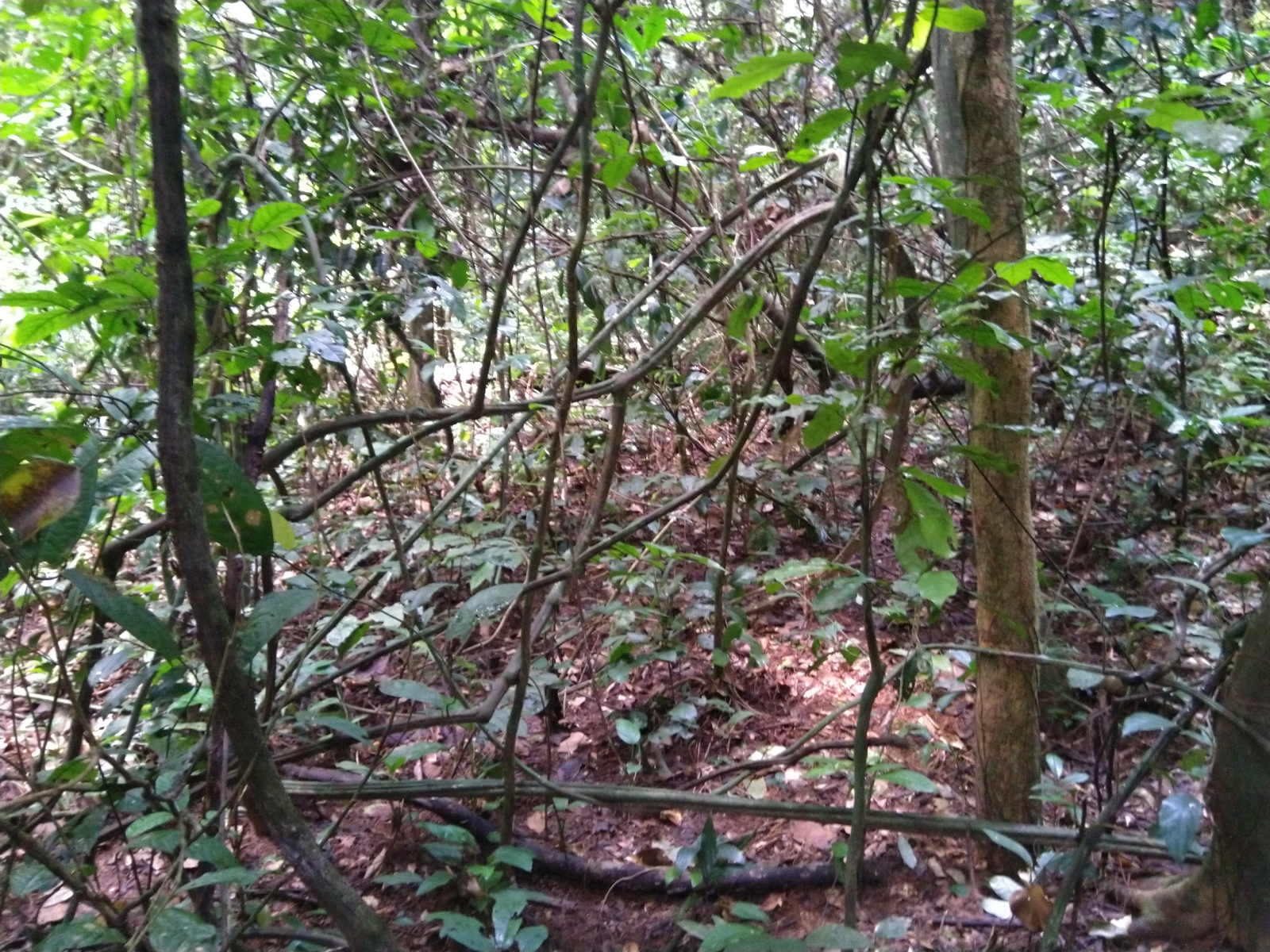
Our work on community ecology involves conducting inventories in different forest ecosystem types in Ghana – from forest floor to the forest canopy. Ghanaian forests show remarkable variation with rainfall and soil patterns. Such variation lies behind the classification of forests in Ghana. In our study, we would like to find out how these variations influence species distribution and interaction patterns.
Community Ecology Projects
November 2022 – Fast-start funding for joint projects on topics related to Africa by the Universities of Hohenheim and Tübingen on the theme Geo- and Biosphere in Africa: Diversity, Change and Opportunity (BioGARD). Grant Award for a pilot study on “Structure-stability relationships in tree-liana interaction networks.”
July 2021 – International Foundation for Science (IFS) Grant D-6590-1 to investigate Liana community structure in relation to climatic and edaphic factors across five forest ecosystem types in Ghana.
Community Ecology Publications
- Ofosu‐Bamfo, B., Addo‐Fordjour, P., Belford, E.J., Krishna Moorthy, S.M. and Verbeeck, H., 2025. Patterns and drivers of liana community structure across five forest ecosystem types in Ghana. Journal of Ecology. https://doi.org/10.1111/1365-2745.70124
- Kumi, S., Nsiah, P.K., Ahiabu, H.K., Ofosu-Bamfo, B., Asigbaase, M., Anning, A.K. and Amponsah, G., 2024. Forest Landscape Restoration-induced Changes in Land Cover and Woody Plant Community Structure in a Degraded Forest Reserve in Ghana. Trees, Forests and People, p.100578. http://dx.doi.org/10.1016/j.tfp.2024.100578
- Addo-Fordjour, P., Ofosu-Bamfo, B., Mbroh, E., Arnold, C.K., Opoku Boadi, A., Mulberry, M., Doe, D.E.K, Oduro Takyi, E. (2022). Plant invasion drives liana and tree community assemblages and liana-tree community structure in moist semi-deciduous forests in Ghana. Biological Invasions http://dx.doi.org/10.1007/s10530-022-02933-0
- Ofosu-Bamfo, B., Addo-Forjour, P. and Belford, E. J. D. (2022). Edge disturbance shapes liana diversity and abundance but not liana-tree interaction network patterns in moist semi-deciduous forests. Ecology and Evolution http://dx.doi.org/10.1002/ece3.8585
- Addo-Fordjour, P., Marfo, I., Ofosu-Bamfo, B. (2021). Fragmentation drives liana community structure but not the patterns of liana-tree interaction network in two forest ecosystems in Ghana. Ecological Research http://dx.doi.org/10.1111/1440-1703.12258
- Addo-Fordjour, P., Antwi Agyei, L., Ofosu-Bamfo; B., Issifu, I. N., Osei, G. O., Appiah-Kubi, R., Bremang, E. K., Koroduah P. O. (2021). Temporal dynamics of liana communities in moist semi-deciduous forests with different management histories in Ghana. Forest Ecology and Management http://dx.doi.org/10.1016/j.foreco.2021.119042
- Addo-Fordjour, P., Kadan, F., Rahmad, Z. B., Fosu, D. and Ofosu-Bamfo, B. (2020). Wildfire causes shifts in liana community structure and liana-soil relationships in a moist semi-deciduous forest in Ghana. Folia Geobotanica (1-15). http://dx.doi.org/10.1007/s12224-020-09380-6
- Addo-Forjour, P., Ofosu-Bamfo, B., Kwofie, F., Akyea-Bobi, N., Rahman, F. A. and Amoah, E. (2020). Changes in liana community structure and functional traits along a chronosequence of selective logging in a moist semi-deciduous forest in Ghana. Plant Ecology and Diversity. http://dx.doi.org/10.1080/17550874.2019.1675095
- Ofosu-Bamfo, B., Addo-Forjour, P. and Belford, E. J. D. (2019). Does road-edge affect liana community structure and liana host interactions in evergreen rainforests in Ghana? Acta Oecologica101(2019)103476 doi: 10.1016/j.actao.2019.103476
Community Ecology Datasets
Ofosu-Bamfo, B., Addo-Fordjour, P., Belford, E., Krishna Moorthy Parvathi, S., Yawson, D., Asare, K. B., Buabeng, I. K., Dadeboe, V. O., Wellington, S. N. O., Alhassan, T. A., Offe, E., Baah, P. Y., Owusu, A. A., & Verbeeck, H. (2025). Liana community structure and environmental variables dataset across five forest ecosystems in Ghana [Data set]. Zenodo. https://doi.org/10.5281/zenodo.15620629

